
This article examines how modern sports gambling and social media are reshaping fan behavior — and the growing mental toll on athletes. This article uses images generated by AI.
In October of 2025, the Philadelphia Eagles beat the Kansas City chiefs in a thrilling afternoon football game. After the game, Chiefs star defensive tackle Chris Jones apparently deleted his social media, due to a hot-mic being picked up at the end of the game, where Jones cursed at an Eagles player for showboating. Jones received lots of criticism for this, leading to his account deactivation on Instagram.
Jacksonville Jaguars superstar Travis Hunter also deleted his instagram temporarily due to hate in December of 2024, when pictures and videos involving his fiancé started to surface. Hunter was the subject of mass-hate, and was moved to delete his account so he could focus on the rest of his final season and upcoming NFL draft.

Image created using ChatGPT
Hate has always been part of sports. Rivalries thrive on it, fans feed off it, and the more tension between two teams, the more people tune in. But the kind of hate tied to gambling is different – and far more concerning.
High-level athletes such as Coco Gauff (Tennis), Bo Nix (American Football), and Owen Farrell (Rugby) have publicly shared how sports gambling has changed the type of hate they receive. Instead of traditional fan frustration, they now face threats, harassment, and abusive messages from bettors who feel “owed.” Each athlete points to a disturbing shift: when money is on the line, people lose empathy, and the athlete becomes nothing more than a bet slip.
Due to sports-gambling now being promoted by every major american sports league and media franchise, players are receiving hate every single week for “selling a parlay” (a parlay is a group of bets combined for a larger outcome). The promotion of gambling sites like ESPN BET, FanDuel, and DraftKings, has made the hate more accessible.
This is most common in the NBA, where hundreds if not thousands of bets are placed every night, on a player to score a certain amount or rebound a certain amount. Almost every statistical line is a bet that can be placed or added to a parlay. Dozens of NBA players speak weekly and constantly to the media about the hate they get, such as stars Jaylen Brown and Kyrie Irving. According to The Athletic (New York Times) almost 50 percent of players said the partnerships with gambling sites are bad for the NBA.
Now, where does social media come into play?
A study from Loughborough University found that online abuse aimed at elite athletes is “quite prevalent” and increasing. According to the study, up to 1/3 of social posts now contain negative content directed toward athletes. Social media has made it almost too easy for regular fans to be able to message athletes about their gambling problems. This affects some athletes mentally, as there have been some cases where athletes will lash out and respond to fans who complain about the athlete losing their parlay.
Social media creates a constant loop of performance scrutiny, feedback (likes/dislikes), identity reinforcement, and vulnerability. Directly from the NCAA; ““One in three high-profile athletes receive abusive messages from someone with a betting interest.” That means that of the estimated 3600 pro athletes across the four major american sports leagues (NBA, NFL, MLB, NHL) around 1200 athletes receive some form of gambling-caused hate. That number, 1200, is just speaking for gambling too. When it comes to general hate, it would be safe to say almost every professional athlete gets some form of it one way or another.
How has gambling affected viewership?
In a sense, the combination of gambling and social media HAS enhanced the sports-viewing experience. The combination promotes viewers to stay watching the game, instead of flipping through channels or even other games. Gambling on a game promotes the idea of staying on that one game, which increases viewer retention rate and average viewer watch time.
Viewer watch time is an important metric for any sports league. According to Forbes, in 2020 the viewership of the NFL dropped, which is interesting due to the Covid-19 pandemic. Because of the pandemic, it would make sense that viewership had gone up, but it didn’t.
In 2021, the NFL partnered with three companies to promote sports gambling (FanDuel, DraftKings, and Caesars) and also saw an increase in average viewership, from 14.9 million in 2020, to 17.1 million in average viewers in 2021. That has been the largest increase in viewership in the last ten years.
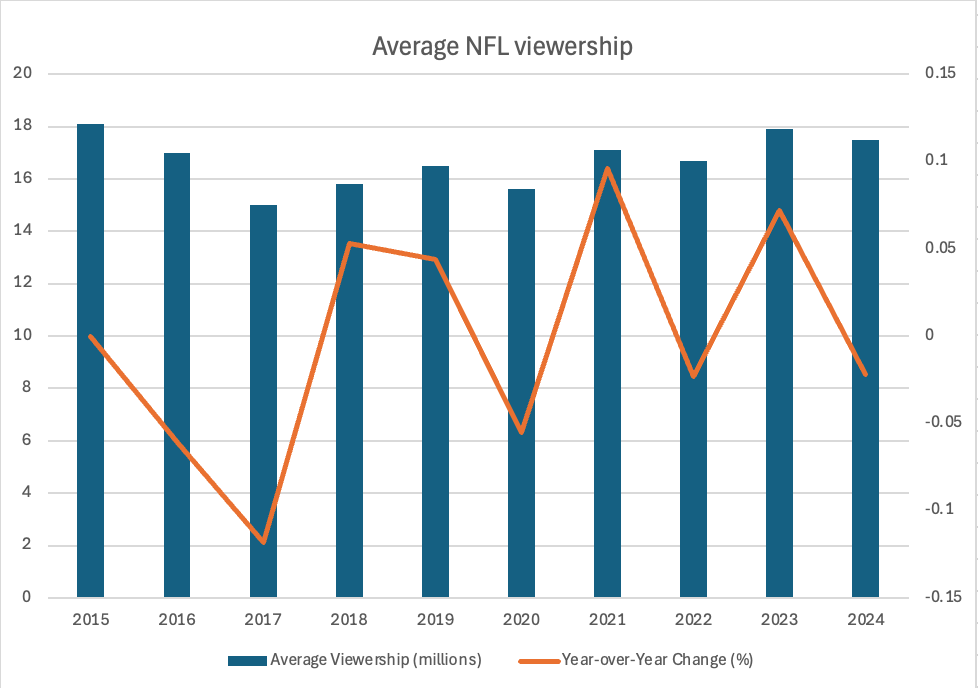
Data sourced from Forbes, The Athletic
While the increase in viewership cannot be directly correlated to leagues gambling promotions, it has been directly correlated to athletes receiving more hate messages than in past years.
Hate has always been a routine part of sports. Yet athletes now face unprecedented levels of hostility fueled by social media and the rise of sports gambling. League partnerships have contributed to this shift by normalizing betting culture. It’s time for leagues to question whether the financial upside justifies the growing threat to their athletes’ mental health.
References
Loughborough University. (2024). Online abuse aimed at elite athletes on the rise – new study. [online] Available at: https://www.lboro.ac.uk/media-centre/press-releases/2024/january/online-abuse-aimed-at-athletes-on-the-rise/
Jane, S. (2025). How sports betting is affecting NFL, NBA, MLB and NHL players. The New York Times. [online] 14 Nov. Available at: https://www.nytimes.com/athletic/6807760/2025/11/14/sports-betting-players-nfl-nba-mlb-nhl/.
NCAA.org (2024). Sports betting culture negatively impacts mental health; NCAA works to support student-athletes. [online] NCAA.org. Available at: https://www.ncaa.org/news/2024/5/17/media-center-sports-betting-culture-negatively-impacts-mental-health-ncaa-works-to-support-student-athletes.aspx
Adgate, B. (2021). In 2020 The Audience Of NFL Regular Season Games Dropped. Forbes. [online] 8 Jan. Available at: https://www.forbes.com/sites/bradadgate/2021/01/08/in-2020-the-audience-of-nfl-regular-season-games-dropped/.

 TJ Deneault
Leave a comment